
Two suppliers can quote the exact same price per kilogram of coco peat and still leave you with two very different final costs. That's because product price is not landed cost. Landed cost is what you actually pay to get usable material into your facility and container loading efficiency sits quietly in the middle of that calculation, doing more work than most buyers give it credit for. The Full Chain: Product → Packing → Container Utilisation → Freight → Destination Charges Landed cost isn't one number. It's the sum of five decisions, each of which affects the next.
Product
The starting point is the quoted price per unit - per block, per kilogram, per bag. This is the number most buyers compare first, and the number that tells you the least on its own.
Packing
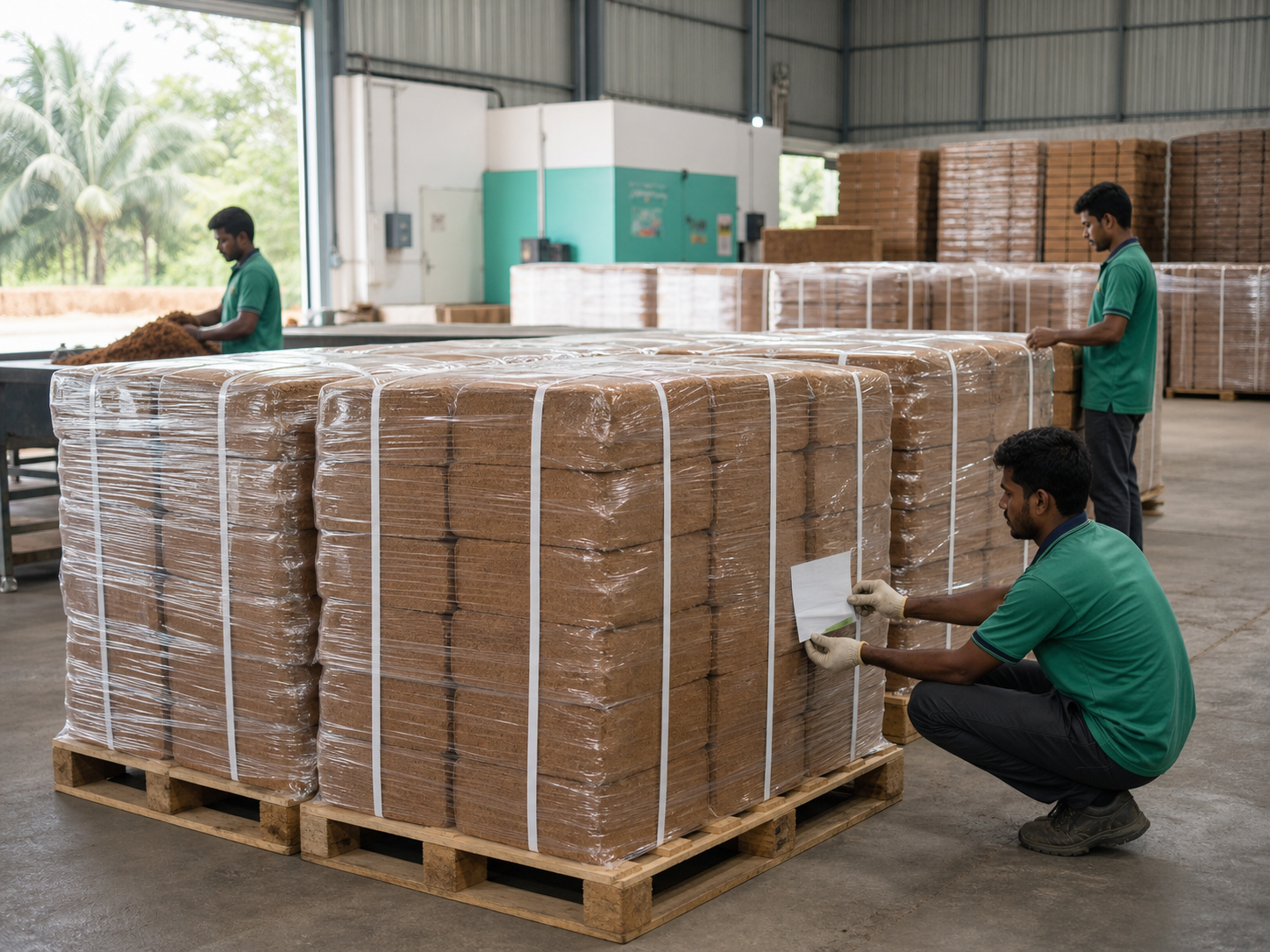
How the product is packed determines its density, its shape consistency, and how well it stacks. A well-compressed, uniformly packed block behaves predictably in a container. An inconsistently packed one leaves gaps, wastes volume, and increases breakage risk, all of which cost money that never appears on the original product quote.
Container Utilisation
This is where packing quality turns into real economics. A container is a fixed cost regardless of how much usable product is inside it. The better the packing, the more product fits per container and the lower your effective freight cost per unit.
Two shipments can use identical containers and identical freight rates, and still produce a meaningfully different cost per kilogram, purely based on how efficiently the product was loaded.
Freight
Ocean freight is priced largely per container, not per kilogram of product inside it. That's exactly why utilisation matters so much, freight cost is essentially fixed, so the only variable you control is how much value you're moving against that fixed cost.
A cheaper quoted product price paired with poor container utilisation can end up costing more per unit landed than a slightly higher quoted price paired with efficient packing.
Destination Charges
Once the container arrives, destination handling, customs clearance, port charges and inland transport all add to the final number. These charges are largely fixed per container as well, which reinforces the same principle: the more usable product inside that container, the less each unit carries in fixed destination cost.
Why Product Price ≠ Landed Cost
Put the chain together, and the point becomes clear: the number on a supplier's price list is only the first input into your actual cost. Two suppliers with identical quoted prices can produce genuinely different landed costs, depending entirely on:
• How well the product is compressed and packed
• How efficiently that packing translates into container utilisation
• Whether freight and destination charges are being spread across a full, well-loaded container or a partially wasted one
For buyers comparing suppliers primarily on quoted price, this is the gap that often goes unnoticed, right up until the cost-per-unit numbers don't match expectations after the shipment lands.
What This Means for How You Evaluate a Supplier
A more sophisticated way to evaluate a coco peat supplier isn't "what's your price," but "what's my landed cost per unit, start to finish."
That means asking about compression consistency, typical container utilisation rates, and how packing format is planned around container dimensions — not just requesting a price list.
Wrapping Up
Product price tells you where the conversation starts. Landed cost shaped by packing, container utilisation, freight and destination charges, tells you what you're actually paying. For buyers sourcing coco peat at commercial volume, that distinction is where real cost control lives.
Want a landed-cost breakdown for your next shipment, not just a price quote?
Reach out to Arjuna Exports →